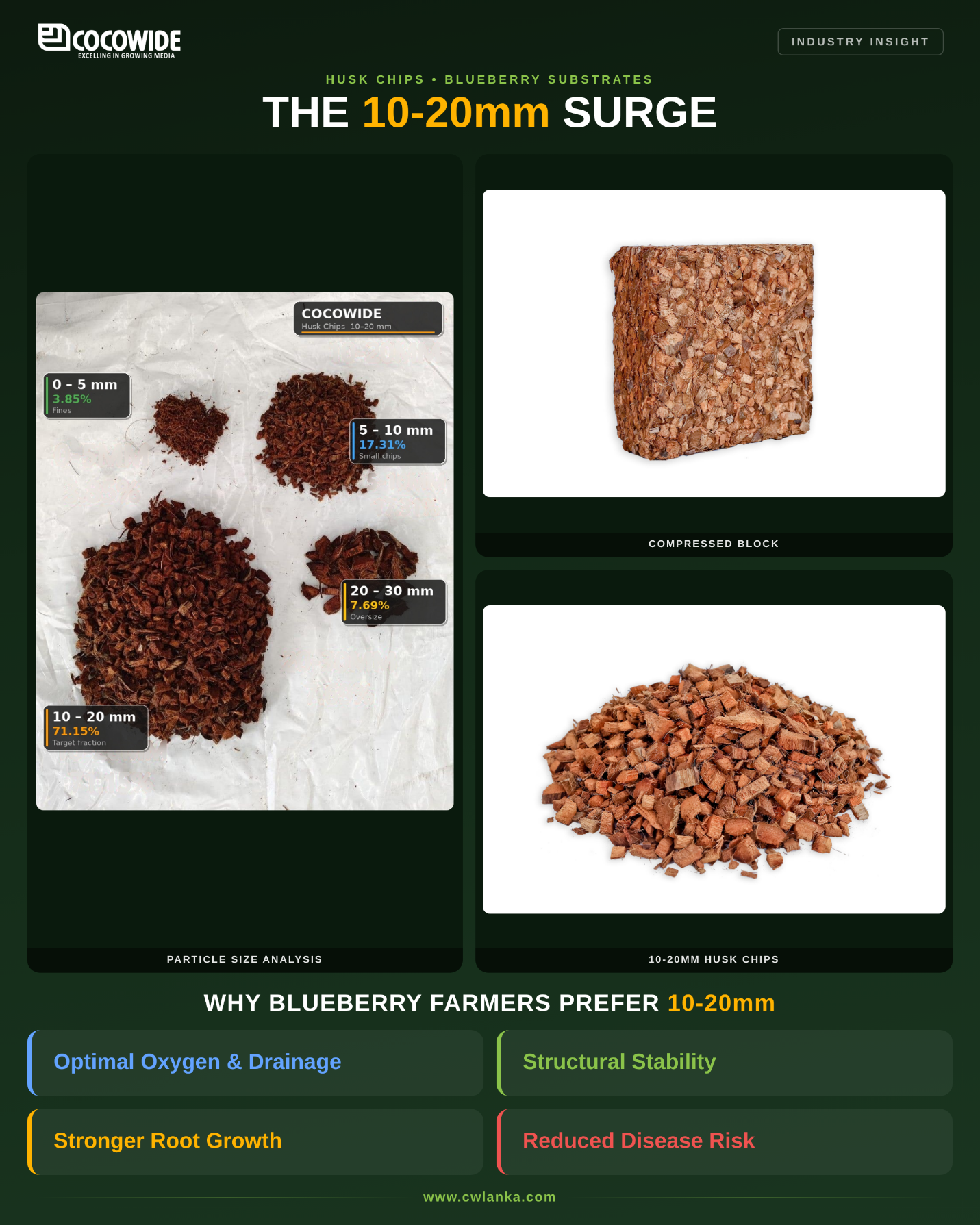
There is a gush of demand for husk chips which are larger than the regular sizes- have been traditionally used in the industry. The reason is that the preference of some Blueberry Farmers for 10-20mm coconut husk chips - already washed to remove excess potassium and Sodium- in their substrates mixture to achieve an optimal air-water balance, providing necessary oxygen for delicate roots while ensuring excellent drainage to prevent rot.
In general addition of coconut husk chips improve structure stability for long-term, multi-year, pot-based crops, reducing compaction and promoting lateral root growth in high-density, controlled-environment, or hydroponic systems and once the size of chips get increased it fundamentally shift the substrate's performance by increasing air-filled porosity and improving mechanical stability while reducing moisture wicking.
In Chinese commercial cultivation of Blueberries where 10-20mm chips are used in large quantities, the husk chips are often blended with cocopeat and peatmoss to maximize both water-holding capacity and air porosity, a mix that is highly popular for efficient- high-yield.
Key reasons for this preference include:
- Optimal Oxygen and Drainage: Blueberries are highly sensitive to waterlogging. 10-20mm chips create large pore spaces, guaranteeing high aeration and preventing anaerobic conditions that cause root diseases like Phytophthora.
- Structural Stability: Unlike fine coir or peat that can break down, these chips maintain a stable structure for several years, reducing the need for re-potting in long-term blueberry cultivation.
- Root Development: The mix encourages stronger, healthier lateral root spread throughout the container.
- Reduced Disease Risk: The high-air, high-drainage environment minimizes the risk of soil-borne pathogens.